

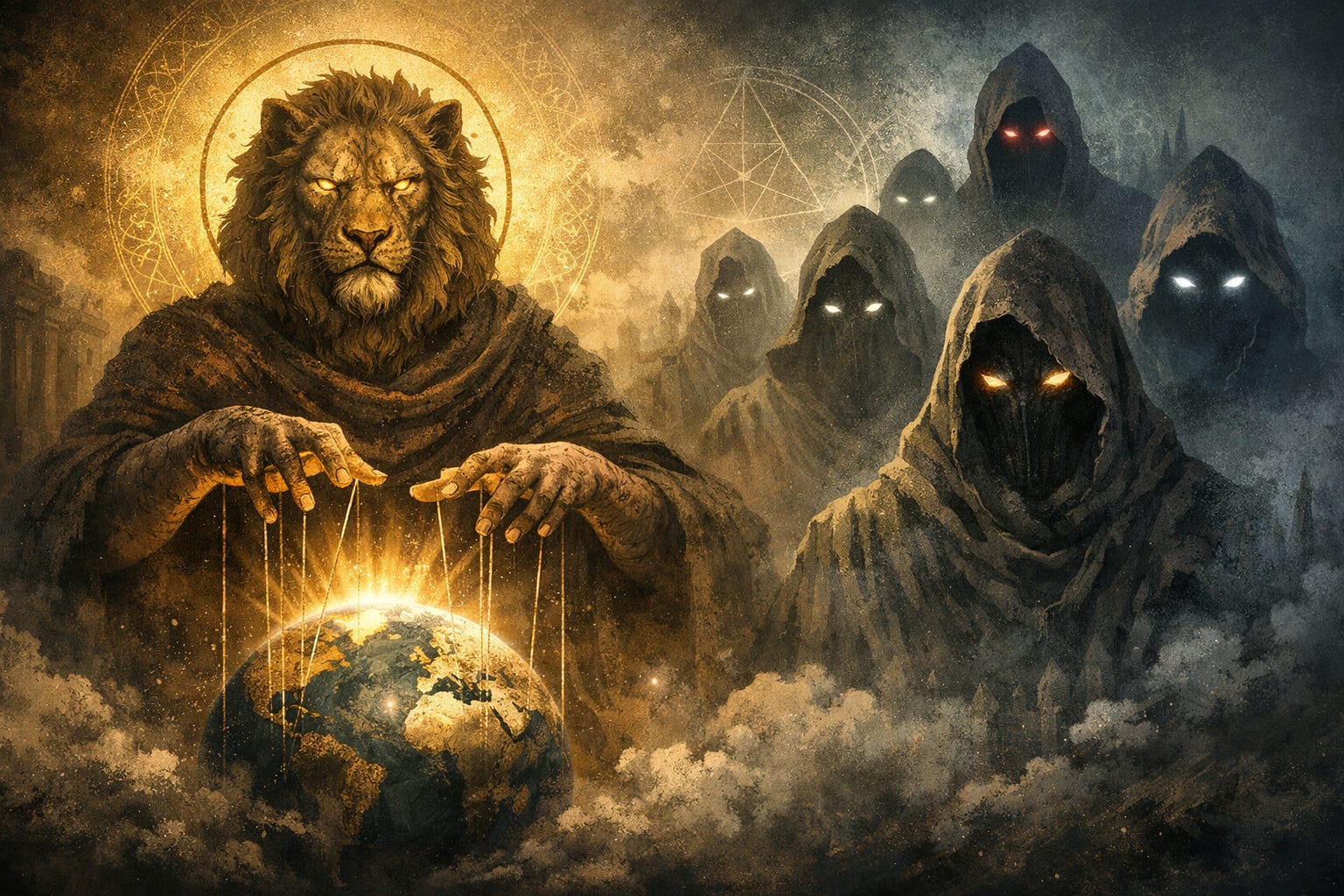
The Demiurge Problem
Not Myth, Not Psychology—Something Harder to Explain

Welcome to Awakening Minds—a publication for open and discerning minds with a metaphysical leaning. To accelerate your evolution with me beyond Substack, you may want to:
Experience the “revolutionary healing science expanding the boundaries of being.” (NEXUS mag) > EVOLVE YOURSELF biofield activations. Next ceremony: Feb 27th, CDMX
Read my first book, THE GRAND ILLUSION: A SYNTHESIS OF SCIENCE & SPIRITUALITY - Book 1 📘 10,000 hours of life-changing research—distilled
Grab a paid Substack subscription to get FULL Substack access (includes all audio 🎧 versions + commenting on all pieces)
The Cosmology That Wouldn’t Stay Dead
There is an awkward fact sitting at the centre of the modern rediscovery of Gnosticism: the old descriptions refuse to stay buried safely in the past.
For over a century, scholars and spiritual writers have tried to domesticate and de-fang the Gnostic worldview by treating it as either just mythology or just psychology. The Demiurge becomes a poetic symbol of ignorance and blindness. (His chief characteristic was, in fact, blindness.) The Archons become metaphors for social conditioning, and the cosmic prison becomes an allegory for the ego in unawareness of its spiritual source.
It is a tidy solution—and also deeply unsatisfying.
Why?
Because the moment you begin reading carefully across accounts of altered states, near-death experiences, visionary traditions, and classical esoteric literature, a strange pattern emerges: certain motifs recur with stubborn regularity. They resemble Gnostic descriptions enough to be uncomfortable, but not enough to be definitive ontologically. Instead, they sit awkwardly somewhere between symbol and structure.
This tension creates what might be called the Demiurge Problem: the structural persistence of Gnostic cosmology in contexts where it theoretically should not exist.
Modern interpreters usually solve the problem by flattening the material into metaphor. But the evidence suggests something more complicated is taking place.
The Demiurge may not be what neo-Gnostic literalists think it is, but it is also unlikely to be merely a symbol.
The gap between those two interpretations—literalism vs symbolism—may be where the real mystery lies. (Speaking of the problem of literalism, see the related article about Loosh ⤵️)
The Return of an Unwelcome Cosmology
When the Gnostic texts were rediscovered at Nag Hammadi in 1945, scholars initially approached them with characteristic scholarly hermeneutic ambivalence—as relics of a lost theological debate. What of it? The Demiurge was treated as an eccentric theological hypothesis: an inferior creator god invented by a particular collection of sectarians who were dissatisfied with orthodox Christianity.
From what I have gathered, this interpretation remains dominant today.
The Demiurge is usually described as a mythological expression of alienation, an attempt to explain the experience of living in an imperfect or seemingly hostile world. Under this model, the Archons are little more than poetic descriptions of psychological limitation.
Yet even a superficial reading of the primary sources complicates this interpretation. The Gnostic writers consistently describe the Demiurge and Archons not merely as ideas but as structures—systems that operate according to identifiable patterns.
They are portrayed as regulators, gatekeepers, and administrators. They organise experience. They shape perception. They influence belief. These latter functions make them easy to characterise as intrapsychic functions of the ego-mind. We could then expect them to show up wherever humans have liminal experiences.
But more strikingly, they are said to operate most clearly in the post-mortem state.
This is precisely where the modern data becomes difficult to ignore.
Persistent Post-Mortem Motifs
Across cultures and historical periods spanning thousands of years, reports of NDEs and visionary states display a number of recurring elements.
These include:
Encounters with apparently authoritative presences
Structured environments governed by implicit rules
Experiences of review, judgement, or evaluation
Attempts at persuasion or guidance
A sense of being directed or processed
These motifs are not all universal, but they are common enough to form a recognisable pattern.
What makes the pattern striking is not merely its repetition but its organisation. Much to the chagrin of materialist “sceptics,” the experiences often display a degree of coherence that far exceeds what one might expect from random hallucination or purely subjective imagination.
The environments appear structured rather than chaotic, while the seemingly intelligent presences encountered often display consistent roles. The interactions frequently involve negotiation, instruction, or evaluation.
In other words, the experiences appear systemic, and this systemic quality is precisely what Gnostic cosmology emphasised.
The Archons were not simple demon-like entities in a folkloric sense, but were administrators of a structured domain. This characterisation is too strong to dismiss casually, yet too incomplete to accept uncritically.
This leaves us with a genuine interpretive problem.
Beyond Myth or Psychology
The most common modern solution is to interpret Gnostic cosmology psychologically.
Writers influenced by figures such as Carl Jung have argued that Gnostic myths describe internal psychic processes rather than external realities—and they do so with some justification. The Demiurge becomes the ego, while the Archontic minions become complexes or conditioned patterns of thought.
This interpretation has real strengths and it explains why the symbolism resonates so deeply. It also accounts for the visionary intensity of Gnostic experience.
But it fails to explain the transpersonal structural consistency of certain reports.
Psychological symbolism tends to be fluid, varying widely between individuals and cultures. Yet many post-mortem and visionary accounts display surprisingly stable features. Even when interpreted symbolically, the experiences retain a structural quality that resists reduction to personal imagination.
On the other hand, literalist interpretations create even greater problems.
In recent years, popular internet discussions have revived a crude version of Gnostic cosmology—referred to elsewhere as Gnosticism Lite—in which Archons operate as literal jailers preventing souls from escaping a cosmic prison. According to these theories, the Demiurge is a malicious anthropomorphic entity controlling the afterlife through deception.
This view has the virtue of taking the original texts seriously, while its downside is it simultaneously introduces a host of difficulties that are rarely acknowledged.
Among them:
The original texts are internally inconsistent.
Key terms are notoriously difficult to translate.
Descriptions vary widely between Gnostic sources.
The cosmologies often contradict one another and can’t all be literally true.
If the Demiurge were a literal cosmic tyrant operating exactly as described in modern “Soul Trap” theories, one would expect far greater consistency across the sources. His totalising control system should be experienced similarly across cultures and centuries.
Instead, what we find is a mixture of precision and ambiguity: detailed descriptions embedded within unstable and ambiguous conceptual frameworks.
The structure persists while the interpretation and emphasis shift.

The Problem of Translation
One of the least discussed aspects of Gnostic literature is the degree to which it is mediated by translation. The surviving texts passed through multiple linguistic layers: Greek, Coptic, and modern European languages. Each stage introduced interpretive decisions that shaped the meaning of key terms.
Words translated as “rulers,” “powers,” or “authorities” carry a range of possible meanings that do not map cleanly onto modern categories.
Terms rendered as “heavens” or “realms” may refer to states of consciousness just as easily as locations. Descriptions interpreted as physical barriers may originally have indicated perceptual or cognitive thresholds—we see this in modern NDEs where a mist or a river symbolises transition into a new state of consciousness.
In other words, the Gnostic texts contain a degree of semantic compression that is easy to mistake for literal description.
When modern readers reconstruct the cosmology, they often assemble these fragments into a system that appears far more concrete than the original material warrants. The reification goes largely unchecked.
This is one of the reasons modern literalist interpretations tend to feel persuasive at first glance: they impose convenient clarity on ambiguous source material.
But clarity achieved through over-simplification is rarely trustworthy.
Structural Reality Without Literalism
Fortunately, a genuinely phenomenological and empirical approach does not require us to dismiss the entire framework simply because literalism fails.
One of the more interesting possibilities is that Gnostic cosmology describes structural features of consciousness that appear reliably under certain conditions, such as visionary experiences and NDEs; the egoic structure is partially (or entirely) loosened from the usual physical constraints.
The aforementioned structural features may manifest as environments, presences, or systems of interaction without requiring the existence of literal cosmic bureaucracies.
The Gnostics themselves frequently hinted at this ambiguity. Their descriptions often blur the line between inner and outer experience.
The Archons are described simultaneously as cosmic rulers and as forces operating within the human psyche. Both are valid, since it is meaningless to speak of any experience of the cosmos independently of the psyche.
The Demiurge is portrayed both as a creator god and as a principle of misperception.
Rather than resolving the tension, the texts actually preserve it, suggesting the authors may have been describing phenomena that resist simple classification.
The modern insistence on choosing between symbol and literal reality may be an artefact of later intellectual frameworks rather than a reflection of the original insights.

The Authority Problem
One of the most intriguing aspects of the Gnostic descriptions is their emphasis on authority. Archontic figures are frequently portrayed as asserting jurisdiction. They claim the right to judge, direct, or assign souls. They serve as cosmic gatekeepers.
Yet the texts also emphasise that this authority is conditional. Knowledge (gnosis) is repeatedly described as the means by which these powers lose their influence.
This feature of Gnostic teachings does not work if the Archons are interpreted as omnipotent jailers. But it makes perfect sense if they represent systems that depend on recognition and compliance.
The emphasis on persuasion rather than coercion appears repeatedly, for example in The Hypostasis of the Archons.1 This detail alone should give pause to literalist interpretations that portray the afterlife as a rigidly enforced soul prison.
Attempts at persuasion imply limits to any supposed authority, and suggest a system that operates through influence rather than absolute control.
This distinction is rarely explored in modern discussions where literalist cosmologies tend to flatten nuance and inflate perceived threats.
Yet these acts of persuasion may be one of the most important clues left by the original writers.
A Cosmology That Refuses Simplification
The Demiurge Problem ultimately arises because the Gnostic model is neither fully mythological nor fully empirical, defying easy categorisation.
It describes recurring patterns without providing a stable explanatory framework—for example:
The Demiurge is portrayed as both a being and a principle.
The Archons appear as both presences and systemic processes.
The cosmology reads simultaneously like theology, psychology, and phenomenology.
Modern interpreters typically resolve this ambiguity by collapsing the model into a single category, but the persistence of the underlying patterns suggests that something more complex is being described.
The Gnostics may have been attempting to map a domain of experience that lies between subjective imagination and objective reality. If so, their cosmology may represent an early attempt at phenomenological description rather than merely serving as systematic theology.
The Archons would then represent not the foot soldiers of a literal cosmic tyrant nor a mere symbol of egoic limitation, but a structural feature of experience—a recurring pattern that appears whenever consciousness encounters certain thresholds.
The Real Challenge
The real challenge posed by the Demiurge Problem is not theological but epistemological. How should we interpret experiences that display consistent structure without clear ontological status?
Dismissal as myth leaves too much unexplained, while simple literalism introduces contradictions that cannot be resolved. Mainstream academia has not resolved the tension satisfactorily, while public online discussion of Soul Trap literalism leans more and more in a carnival-like direction.
The middle ground is uncomfortable because it requires accepting that structured experiences may exist without fitting neatly into modern categories. This possibility challenges both materialist scepticism and spiritual literalism.
It suggests that ancient esoteric traditions may have preserved partial descriptions of experiential domains that modern frameworks struggle to interpret. And if this is the case, then the Gnostic texts may be neither obsolete theology nor mere psychological fantasy.
Instead, they may represent incomplete maps of a real but poorly understood psycho-spiritual territory. The Demiurge Problem remains unresolved precisely because the evidence points in multiple directions at once.
The Archons appear structured yet ambiguous; systemic and yet spectral. The Archons behave as if part of a system—without being reducible to concrete entities.
The Demiurge appears persistent and near-universal, yet elusive.
The cosmology refuses to collapse cleanly into either metaphor or mechanism.
And it is possible that this refusal is not a defect in the material but a clue to its true nature. The most productive approach may not be to shoehorn the Gnostic worldview into modern categories, but to examine the structural patterns carefully enough that a clearer picture begins to emerge.
Until that work is done, the Demiurge will remain exactly what the Gnostics themselves implied he was: Not a simple and ignorant villain in a cosmic drama—but the shadowy silhouette of a system we are participating in and yet do not yet fully understand.
A more careful cross-tradition reading of sources suggests the problem may be less obscure than it appears. Some of the confusion may lie not in the phenomena themselves, but in how they have been transmitted—a problem examined in detail in Book Two, with startling results.
About Brendan & His Other Offers
Brendan D. Murphy researches consciousness, post-mortem models, non-physical perception, and the origins of modern metaphysical narratives. His work synthesises contemporary data with classical esoteric frameworks, most notably in The Grand Illusion Book 2—a cutting-edge study into the afterlife (coming soon!). Grab your copy of the first volume “The Grand Illusion: A Synthesis of Science and Spirituality — Book 1”

UPGRADE YOURSELF with a “revolutionary healing science expanding the boundaries of being.” Watch the masterclass to learn how this transformative evolutionary biofield activation and healing work with sound could change your world. Click to watch and save your seat for the next live ceremony


http://www.markfoster.net/rn/archons.pdf
Thank you, Brendan. This subject is, indeed, rife with controversy and interpretative variance! I appreciate your perspectives very much.
This was SO satisfying and enjoyable to read. I am going to go through it again several times before I comment further, but I just had to say how much I enjoyed reading it. I've been thirsty for something like this, it was like a long drink of cool clear water. Thanks so much, Brendan <3